
VX SUITE
Fiber Virtual Network Operator
FVNO enables a second operator to establish its own wholesale operator domain on an existing fiber access network managed through VX Suite.
Book a demo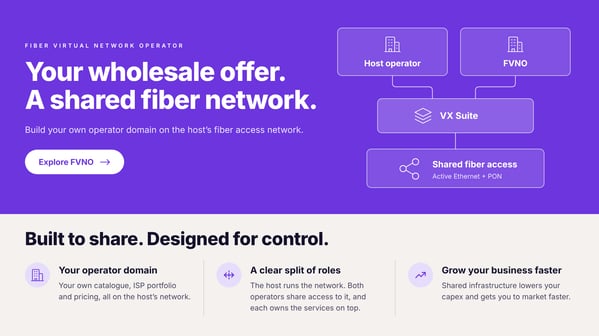
THE CHALLENGE
When you need more than just an API from the network operator
DISCONNECTED SYSTEMS
Provisioning, inventory and diagnostics live in separate tools that don't talk to each other.
MANUAL RECONCILIATION
Every new subscriber, address or piece of equipment means reconciling records by hand.
VENDOR LOCK-IN
Point integrations get built one at a time, tying operators to specific hardware and slowing every new request.
WHY FVNO
Why is the FVNO model needed?
A national or regional operator wants to offer fiber services in a network it does not own. Joining only as an ISP would mean using the host operator’s product catalogue, handover and processes. Leasing passive access would provide more technical freedom, but would also require active equipment, rack space, field work and ongoing maintenance in each PoP.
FVNO provides a third route. The entrant receives its own operator domain, approved products and ISP portfolio, while reusing the host network’s existing active and passive access infrastructure. This can shorten time to market, reduce network-side work and support a more consistent customer journey across several host networks.
OPERATING MODELS COMPARED
Where FVNO sits between passive access and standard active sharing
BUILD YOUR OWN
Passive network lease
- Own active equipment in host PoPs
- Maximum technical freedom
- High capex, rack space and field work
- Repatching normally required
THE THIRD ROUTE
FVNO
- Own logical operator domain
- Own products and ISP portfolio
- Shared active and passive access
- No duplicate access stack in host PoPs
USE THE HOST’S PRODUCT
ISP on active sharing
- Consumes host wholesale product
- Fast and low infrastructure burden
- Host catalogue and workflows
- Limited operator-level control
| More infrastructure responsibility |
|
Less infrastructure responsibility |
ARCHITECTURE
The logical FVNO architecture
Two operator ecosystems use the same VX Suite and access infrastructure
Retail services
Host ISPs and FVNO ISPs, including an optional FVNO retail ISP
Operator domains
Host ANO and FVNO: separate catalogues, subscriptions and permissions
VX Suite
Shared access-point model, ordering, provisioning and service status
Shared network
Host active and passive access, with separate traffic handovers
Logical view. Network operation and managed services follow the agreed responsibility model.
Benefits
01
Faster time to market
Launch fiber services in networks you do not own by reusing the host network’s existing active and passive access infrastructure.
02
Less network-side work
No need for your own active equipment, rack space, field work or ongoing maintenance in each PoP.
03
One customer journey
Your own operator domain, approved products and ISP portfolio, delivered consistently across several host networks.
FVNO is related to Open Access, but is not identical
Open Access is primarily a market and wholesale principle: multiple service providers can compete on a network through defined products and processes. FVNO is a technical and operational model that extends this principle by creating a second operator domain above the same access infrastructure. Both the Host ANO and the FVNO can then operate their own Open Access ecosystems and ISP portfolios.
BOOK A DEMO
See how FVNO works in VX Suite
Get a walkthrough of how a second operator can run its own domain, products and ISP portfolio on an existing fiber access network.
Book a demo