

Network lifecycle management aligns people, processes and platforms across every stage of a fiber network: plan, build, activate, assure, optimize and refresh. Done well, it shortens time to service, improves SLAs, lowers cost to serve, and creates a transparent, neutral foundation for multi-ISP growth.
What network lifecycle management really means
Network lifecycle management spans investment choices, design standards, build quality, activation workflows, assurance, capacity growth and technology refresh. The aim is simple: every new street, cabinet, splice, OLT and service should move smoothly from design to live operation, with clear accountability and measurable performance at each step.
“If design, inventory and operations don’t speak the same language, you pay for it later,” says Johan Moreau, Chief Information Officer at VX Fiber. “A single, trusted model of the network lets you automate activation, predict faults and plan expansions with confidence.”
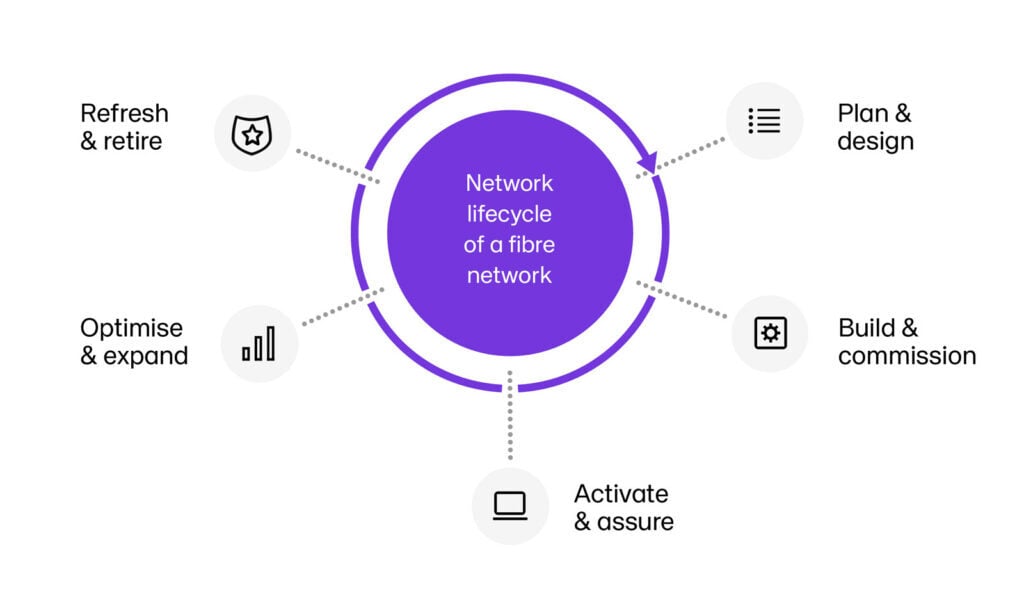
The lifecycle at a glance
Plan & design: prioritize footprints, model demand and costs, and create standards for fiber architecture, resilience and service tiers.
Build & commission: control quality in civils and fiber works, reconcile ‘as-built’ into inventory, and certify handovers.
Activate & assure: use zero-touch provisioning (ZTP), policy templates and tests; monitor QoS, SLAs and MTTR.
Optimize & expand: track utilization, remove bottlenecks, and extend coverage where ROI is proven.
Refresh & retire: plan upgrades (e.g., XGS-PON) and decommission safely with full audit.

Network lifecycle management in open-access environments
In an open access network, neutrality is non-negotiable. Lifecycle decisions must be transparent, with standardized onboarding, shared service catalogs and consistent reporting for every provider. This protects fairness while giving end users real choice, and it allows owners to scale without vendor lock-in.
“Neutrality by design isn’t a document, it’s how you operate,” Moreau notes. “When lifecycle processes and APIs are the same for all ISPs, competition shifts to quality of experience, exactly where it should be.”
Data, automation and the source of truth
Reliable lifecycle management depends on accurate inventory and topology, the source of truth that ties physical fiber to logical services. With that in place, automation can do the heavy lifting: zero-touch activation, change control with guardrails, proactive assurance that correlates alarms to customer impact, and analytics that prioritize the next build. Digital-twin modeling helps test “what-if” scenarios before you commit crews or capital.
KPIs that prove lifecycle value
Measure end-to-end outcomes, not just tasks. Track planning lead time and build velocity; order-to-activate time and first-time-right; availability and MTTR; utilization, cost to serve and energy per service; take-up per footprint and churn/NPS. Publish shared dashboards so municipalities, ISPs and stakeholders see the same facts. For operational context, explore fiber network management.
Common pitfalls, and how to avoid them
Three patterns derail many program. First, incomplete ‘as-built’ data: reconcile field works into inventory the moment you commission. Second, manual activation steps: standardize with templates and ZTP to reduce variation and delays. Third, siloed reporting: align SLAs, incident severity and communications so every provider is managed on equal terms.
For neutral policy context on broadband goals and efficient deployment across Europe, see the European Commission’s connectivity policy overview.